


What is Kabini
Kabini is the codename for low-cost, power-efficient Accelerated Processing Units (APUs) from AMD. These APUs were launched in 2013 and designed to fit into entry-level laptops. AMD saw the potential for Kabini APUs on the desktop and has since launched socketed versions in April 2014. Socketed, in this sense, means that there is a clear upgrade path for subsequent improved versions, which is in line with most other desktop-based processors available today.
These Kabini APUs can also be referred to as system-on-chip (SoC) processors. This is because each Kabini APU integrates the CPU, GPU, memory controller and I/O on to one piece of silicon. The reason for doing this is it simplifies the design of supporting motherboards and enables AMD to tease out the best synergy between the different parts that constitute the Kabini APU.
Modern technology
The technology behind Kabini can be split into two broad camps. The CPU segment is designed around the power-efficient Jaguar core that is also found in the Sony PlayStation 4 and Microsoft Xbox One consoles. On the laptop and desktop fronts, up to four Jaguar cores can be integrated into Kabini silicon.
Kabini's GPU portion is based around the very latest Graphics Core Next (GCN) technology used in discrete, add-in cards. It is the same technology found in the world's fastest graphics card, the Radeon R9 295X2, albeit presented with fewer processing cores than on the gaming goliath.
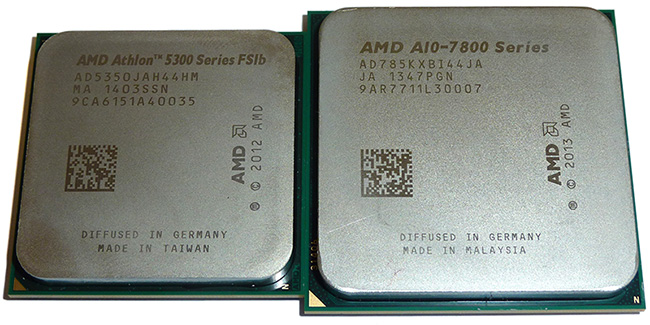 |
Kabini on the left, Kaveri on the right |
AMD understands that Kabini APUs will be used in systems that require strong multimedia credentials. To this end, Kabini has a flexible array of video outputs - including DVI, HDMI, DisplayPort and VGA - and modern video accelerators, such as Video Codec Engine (VCE) and Universal Video Decoder (UVD), enable Kabini systems to play high-definition video with minimal APU load.
Referencing the recent introduction of desktop-socketed Kabini APUs, four models are now available from AMD's retail partners:
| APU Model | CPU Cores |
CPU Clock (MHz) |
GPU Brand |
GPU Cores |
GPU Clock (MHz) |
Max. DDR3 (MHz) |
TDP (watts) |
Launch Price (US 1ku) |
|
|---|---|---|---|---|---|---|---|---|---|
| 28nm Kabini | |||||||||
| Athlon 5350 | 4 |
2,050 |
Radeon R3 |
128 |
600 |
1,600 |
25 |
$59 |
|
| Athlon 5150 | 4 |
1,600 |
Radeon R3 |
128 |
600 |
1,600 |
25 |
$49 |
|
| Sempron 3850 | 4 |
1,300 |
Radeon R3 |
128 |
450 |
1,600 |
25 |
$39 |
|
| Sempron 2650 | 2 |
1,450 |
Radeon R3 |
128 |
450 |
1,333 |
25 |
$35 |
|
Value and performance
Retail Kabini APUs are known as either Athlon or Sempron processors. Value is very much a key selling point, with supporting motherboards available from just $30.
The AMD Kabini APU makes it possible to build a feature-rich, energy-efficient PC that also goes light on the wallet. It is an important product for both emerging countries, where budgets are constrained, and the developed world, where it fits the bill for a second PC in the home or as mass-deployed systems in an office environment.
Designed to cater for the types of applications that most users run today, the AMD Kabini APU offers best-in-class performance for budget PCs. Want a do-it-all processor that doesn't break the bank? The AMD Kabini is a fine choice.