


What to lookout for in an AMD system
It is a well-known fact that AMD is the only company that manufactures CPUs, APUs and discrete graphics cards for the consumer market. Producing three of the most important parts in a modern system means that AMD is able to create the backbone of a cutting-edge PC, at all budgets and for all form factors.
So, what should you be looking out for if deciding to go down the all-AMD route for your next build. We've lined up three systems, of varying budgets, and identified some of the key factors you should be looking into.
The budget build - £500 budget
The obvious choice for a value-orientated PC is to base it on an AMD APU. The latest in a long, successful line uses the Kaveri architecture that incorporates Steamroller CPU and GCN graphics technology. These APUs start at around £80 and rise to £110 for the range-topping A10-7850K model.
Supporting these APUs are motherboards using the FM2+ chipset. Most also feature a technology called Dual Graphics, whereby the APU's graphics component is teamed up with a discrete card that's also based on the latest GCN technology. Doing so enables extra performance for effectively free.
High-spec motherboards tend to ship with extra USB 3.0 ports, additional RAID capability, and the ability to run two discrete AMD Radeon graphics cards in tandem through software-based CrossFireX technology. For the purposes of the £500 build, however, a Radeon R7 260X or Radeon R7 265 are ideal graphics cards to be paired with either an A8 or A10 APU. The net result is a system that is capable of playing modern games at a full 1080p resolution while being more than powerful enough for everyday tasks such as emailing and high-definition video playback.
Deluxe build - £1,000 budget
Doubling the budget for an AMD system has important ramifications for the consumer. Here, the best course of action is to consider a discrete CPU from the FX line of processors. With more cores at the ready and higher speeds possible through overclocking, an FX-8350, for example, is a good bet.
Providing the backbone to this processor is the AM3 chipset. All the major motherboard manufacturers in the world produce various versions, and, just as you would expect, features increase as the budget is improved.
Assuming at least on-third of the overall budget is left for the graphics, which is sensible, the Radeon R9 290, released in November 2013, is a fine bet. Based on the same technology that powers the Radeon R9 295X2 and Radeon R9 290, this top-end card is a great candidate for playing games at the 2,560x1,440 resolution present on high-end monitors.
Ultra-enthusiast build - unlimited budget
AMD also has solutions for the money-is-no-object crowd. The FX-9590 eight-core processor is the only consumer model running at a blistering 5GHz. It also runs on the same AM3-based chipsets as highlighted on the deluxe build, but the choices would veer towards the premium end of the market, where manufacturers take time and effort into producing motherboards that are stable at highly-overclocked frequencies. This requires extra attention and cooling for the voltage regulators and particular care in the BIOS.
The ultimate build deserves the ultimate graphics card. Right now, there is no better single graphics card than the Radeon R9 295X2. This benchmarking behemoth takes in two premium Radeon R9 290X GPUs, places them on one board, and overclocks them further. Such speed requires that the R9 295X2, or two for that matter, be watercooled, and it's sensible to have the complete system watercooled for maximum performance and minimum noise.
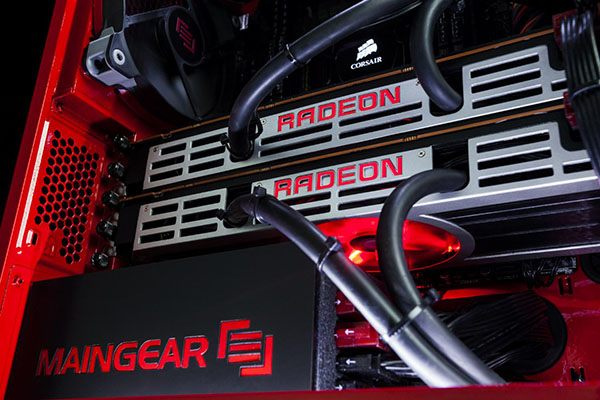
Understanding what AMD offers requires some basic knowledge of the products in each segment of the market. AMD's ability to service both the CPU and GPU elements of a build puts it in a unique position. Want a competitive PC at every portion of the market? AMD has you well-covered from every point of view.